
Helsinki metropolitan area is one of the most innovative regions in Europe and ambitious in developing further with a highly collaborative mindset.
A broader shift is taking place in the way public innovation activities are understood and implemented. As highlighted in the original operating environment analysis (by Demos Helsinki, 2022) prepared for the programme, the role of the public sector in innovation policy has evolved significantly over the past decade. Whereas public authorities were previously seen mainly as providers of favourable operating conditions and correctors of market failures, there is now growing recognition of the need for a more active, strategic, and mission-oriented public sector.
The 2022 analysis examined this transformation broadly. This article focuses on HEVinnovations and, based on the programme coordination team’s assessment, how it has advanced the transition to a new innovation paradigm. However, progress has varied across different areas.
The cities of the Helsinki Metropolitan Area have strengthened their capabilities as intermediaries alongside their traditional enabling role. This intermediary role has also reinforced their capacity to act as strategic visionaries. Innovation actors in cities increasingly require a strong vision to connect stakeholders, thematic areas, and services into coherent innovation ecosystems.

The old paradigm relied heavily on traditional business advisory services and support mechanisms. Although the City of Helsinki and other metropolitan cities had already developed a diverse service portfolio before the HEVinnovations programme, the programme has enabled stronger regional development, the expansion and complementing of existing services, and deeper cooperation across the metropolitan area.
The programme has provided an opportunity to launch funding calls in areas where cities themselves have identified development needs, ensuring that resources are directed effectively towards metropolitan development priorities.
This programme period has also placed greater emphasis on multidisciplinary collaboration and substantive content development. However, such work requires long-term and sustained investment if it is to become the new normal and provide stronger responses to systemic societal challenges.
Although sustainable development has been embedded throughout the programme, its primary focus remains on supporting business growth and competitiveness, which is appropriate given the programme’s objectives. At the same time, through new initiatives and ecosystem development activities, the programme has enabled broader regional renewal and contributed to long-term economic vitality.
There has been relatively little change regarding who is recognised as an innovator, as the programme’s primary objective remains the promotion of business growth and competitiveness. Consequently, residents and civil society play a relatively limited role within innovation activities.
Within a programme of this nature, their role will continue to be primarily that of customers, target groups, and, in some cases, co-creators. Nevertheless, by openly sharing urban challenges and development needs, cities can facilitate the emergence of new innovations and create opportunities for a broader range of actors to participate.
The programme is primarily perceived as a funding mechanism and an enabler, and this is indeed a significant part of its role. However, much more takes place behind the scenes. Capital region cities jointly determine the priorities for funding allocation and influence how resources are utilised, including the programme’s requirements regarding collaborative projects.
The programme also actively seeks to strengthen connections between actors: within projects, across projects, and between the cities of the Helsinki Metropolitan Area. A shared agenda is developed through annual network events, open stakeholder dialogue, and by identifying common strategic priorities among the participating cities.
In practical terms, strengthening innovation ecosystems also means enhancing the strategic capabilities of city experts. The programme has supported this particularly through project meetings, networking events, and training activities. Shared forums allow experts to view their own work as part of a larger ecosystem rather than as isolated project tasks.
These interactions generate new insights that influence day-to-day project work and ultimately contribute to greater impact.
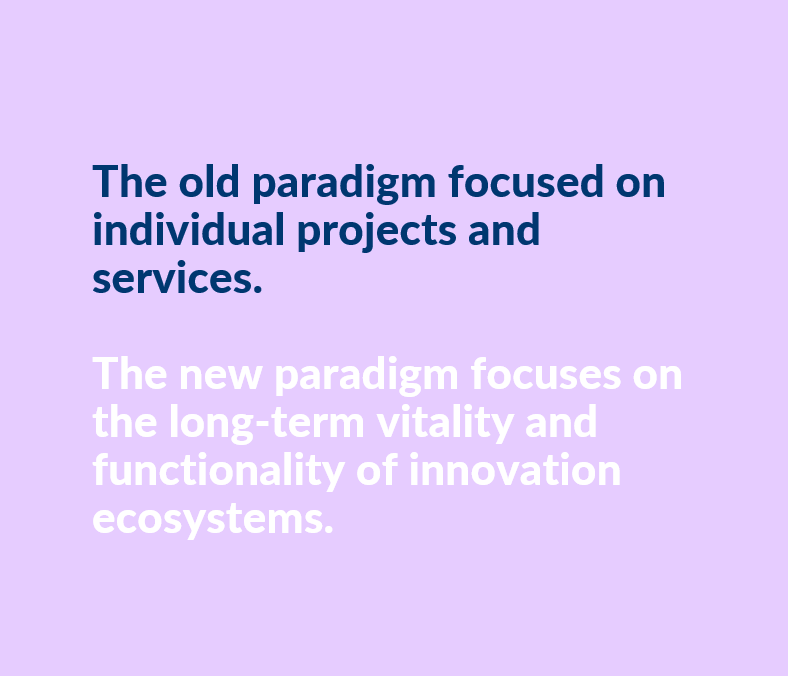
New products and services developed by companies remain at the heart of the programme. At the same time, resources have been allocated to developing and scaling new operating models and practices throughout the metropolitan area.
Unlike many other external funding sources, the regional focus of HEVinnovations has made it possible to develop shared metropolitan practices during project implementation. For target groups, this translates into more comprehensive and locally relevant services.
Both the programme coordination team and individual projects have invested not only in direct business services but also in improving the functioning of the wider innovation system. The objective has been to make the regional innovation ecosystem more efficient, higher in quality, and more accessible.
Service pathways have been refined across project boundaries, and companies’ journeys through the innovation ecosystem have become a central topic in the developmental evaluation discussions conducted with all portfolio projects.
The programme period has also enabled stronger investments in multidisciplinary collaboration and cross-project cooperation, although there remains considerable potential for further development in the coming years.
Before this programme, cities in the Helsinki Metropolitan Area lacked a dedicated funding instrument through which larger strategic project portfolios could be developed. Instead of supporting only isolated initiatives, the programme has enabled cities to design funding calls that address their own development needs and to do so together with regional research, development, and innovation stakeholders.
The programme has also provided projects with opportunities for both formal and informal collaboration, helping to strengthen synergies and networks between different initiatives.
The long programme period has allowed lessons learned from earlier projects to be transferred into later projects and into programme-level development efforts. As a result, programme content and implementation have improved year by year.
Furthermore, the programme has become an important tool for implementing city strategies due to the degree of strategic steering it allows, something that many other external funding sources do not provide. Sparring and support resources offered through the programme have also added value by helping projects become more coherent and higher in quality.

Towards the Next Stage of the Paradigm Shift
Overall, the programme has moved project activities towards the new innovation paradigm. However, a complete transition has neither occurred nor necessarily been desirable, given the objectives of the programme and the constraints of the funding instrument.
The most significant drivers of change have been the cities’ partial ownership of programme content and an operational culture that emphasizes collaboration.
From the perspective of the innovation paradigm shift, the most important remaining challenge is institutional transformation:
A single ERDF-funded innovation programme cannot solve all these challenges. However, the lessons learned from HEVinnovations can be applied much more broadly in public-sector innovation policy and ecosystem development.
The paradigm shift in public-sector innovation is already underway.
HEVi is a joint innovation programme by the cities of Helsinki, Espoo, and Vantaa, designed to strengthen innovation activities and networks across the Helsinki metropolitan area. The programme is based on an innovation ecosystem agreement with the Finnish government, through which the cities will develop an extensive project portfolio between 2021 and 2027. The projects are implemented between 2023 and 2029. The agreement promotes the strategic allocation of public and private RDI funding and supports the growth of globally competitive innovation ecosystems.