

A Nordic studio redefining immersive design through experience innovation and multisensory storytelling.
There are moments when a place seems to reach out and take hold of you. A forest breathing at a tempo of its own. A path where the rhythm of your steps awakens something half-forgotten in the body. A sauna where the heat folds over the skin like a quiet invitation inward. Such moments don’t appear by accident. They surface in spaces shaped with intention, places where light, material, temperature and an almost imperceptible rhythm meet a person not as a spectator, but as a presence.
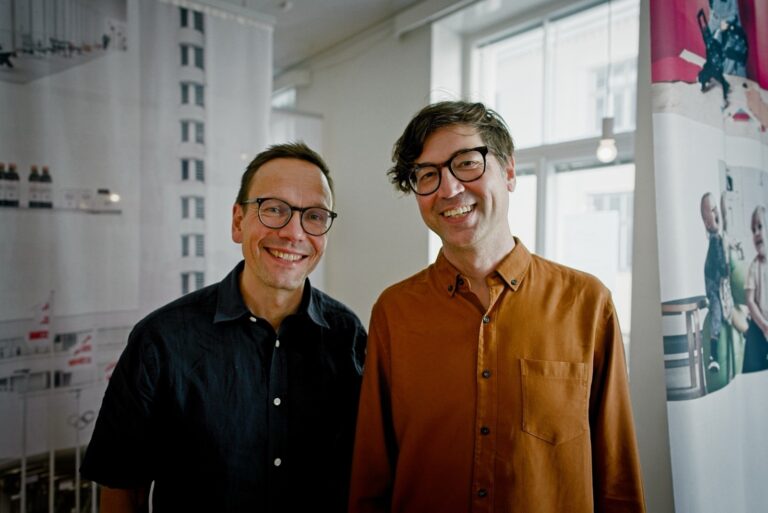
This philosophy forms the foundation of Experience Aika, created by American-Finnish experience designer Mika Johnson and seasoned media producer Jukka Karhula. The company grew from a desire to return people to presence, to an awareness of being here now. In a culture increasingly defined by screens, abstraction and fragmented attention, Experience Aika builds a countercurrent: environments that invite us to pause, breathe and feel. Time, according to the studio, has become one of our greatest luxuries.
They refer to words like “Time, Presence, and nature” as design tools. It is not a technique but a worldview: a way of understanding how humans learn, sense and inhabit the world. Mika explains it simply: “When a person truly slows down, they begin to hear in a new way. When we design for presence, the role of the space is to make that moment possible.”
The intellectual thread running through their work echoes Maurice Merleau-Ponty’s reflections on the body’s fundamental relationship to reality (Merleau-Ponty, 1945). Their work moves in the same direction: the body is not just a vessel for perception but a structure through which meaning is formed.
“We’ve drifted into a situation where people experience the world increasingly through screens,” Mika notes. “That is a disembodied experience, knowing that comes through something being represented rather than through the body itself, which knows through all the senses.”
The promise of technology was greater connection; in reality, it has often severed the connection to our own physicality. Mika knows this intimately. His VR adaptation VRwandlung, based on Franz Kafka’s The Metamorphosis in which Gregor Samsa awakens transformed into an unrecognizable body, allowed participants to step inside that altered perspective themselves. The work revealed how technology can both open new dimensions of experience and, at the same time, narrow the space in which the human being fully senses the world.
Parallel to his VR work, Mika created pieces such as The Infinite Library, The Republic of Dreams and Confessions of a Box Man, works in which literature, anthropology and ritual merged with spatial installation. In these projects, one can already see the impulse that guides Experience Aika: the idea that story lives not only in language but in movement, atmosphere, light and the subtleties of spatial rhythm.
“A spatial artwork is not an object, it is a relationship,” Mika says. “It comes into being the moment a person encounters place, material and light.”
Mika’s trajectory from film and VR to ritualistic spatial practice across the United States and Europe now converges in comprehensive experience design. His approach is inseparable from today’s ecological and technological conversations. Sound, water, light, wind, materiality and the dramaturgy of the senses form a language in his work that exists outside the boundaries of text.
Where Mika shapes the experiential vision, Jukka anchors it. With more than two decades in the media and audiovisual sector, his career spans screenwriting, event direction and the adaptation of global formats such as Top Gear Live, MasterChef and The Apprentice. He has produced, licensed and localized content across markets, navigating cultural nuance and narrative integrity.
“As Mika opens a new way of thinking about space and experience, my role is to ensure the vision can be commercially realized,” Jukka explains. “A good idea is not enough without a structure that carries it.”
His experience leading multidisciplinary teams gives Experience Aika a rare operational confidence, one that moves easily between art, design, technology and travel.
Together they form a partnership fluent in both cultural and commercial languages. Their membership in the WXO network places them among global practitioners reshaping how experiences are created and understood. The network supports their ambition to craft environments with cultural, ecological and social resonance. Their work and experiential services unfold across multisensory pop-up immersions, workshops and retreats.
Among these, the Fire & Ice Sauna Retreat stands out. It reframes the Finnish sauna tradition for international audiences while preserving its elemental core. Heat, water, rest and silence remain the heart of the ritual, but the transitions between them are choreographed so that the body’s rhythm gradually steadies. Participants shift from thought into sensation, opening a space where one can meet both the self and the landscape.
“You cannot understand the sauna by reading about it,” Mika says. “You have to experience it. Knowledge formed through the body is different, it does not remain theoretical.” Here he speaks of embodied knowledge, understanding that arises through physical experience rather than conceptual reasoning.
Guests often describe the moment when intense heat gives way to cold water, a full-body pulse that lingers long after the retreat ends. Wellness tourism research supports this phenomenon: embodied rituals can influence wellbeing for weeks (De Bloom et al., 2017; Global Wellness Institute, 2023).
Experience Aika also creates installations in which their work gives nature a voice. One noticeable example was TUULI by Experience Aika, presented in 2025 for the twentieth anniversary of Helsinki Design Week. The premiere installation, where Tuuli acts as your guide, combined shifting air currents, an ambient composition of wind recordings, bells, and chimes, a custom made scent, evolving light, and tactile materials, such as stones and textiles, inviting visitors to dwell in a space where their imagination could wander freely. These works have drawn international attention, and conversations with museums and cultural institutions continue across continents.
In presence design, attention rests on the dialogue between space and the human being. This idea aligns with principles found in sensory ecology, which views environment as an active guide to perception rather than a passive backdrop (Dusenbery, 1992). Mika and Jukka do not approach this scientifically, yet their intuition moves along its contours: the environment speaks, if one listens.
Their forthcoming workshop series, inspired by their first publication, Field Guide No 1, extends this thinking into a pedagogical form. Participants work with natural materials, listen to the acoustic texture of their surroundings, develop personal rituals and learn to sense how time manifests in the body. This approach is built not on conceptualization but on observation: on breath, movement, sensation and spatial awareness forming understanding. The idea aligns with the tacit knowledge discussed by Polanyi in the 1960s (Polanyi, 1966).
Looking ahead, Experience Aika is building an international program that brings together installations, site-specific retreats, rituals, workshops and research residencies. “We wanted to create a company that offers something the world genuinely needs,” Jukka says. “Spaces that don’t take our attention but instead bring it back to the inner rhythm of the human being, which for us means creating or co-authoring attention with our visitors or participants.”
Their participation in the Kudos³ business accelerator supports the development of their service models and commercialization strategy. They have identified key markets from museums and cultural institutions to corporate leadership and high-end travel, where their approach resonates. Clarifying their philosophy into a form that can be both articulated and scaled is essential, as their work is not a traditional product but an experience offering requiring sensitivity and structural intelligence.
Experience Aika brings us back to a time that doesn’t slip away but remains. They create spaces that make time visible: in the movement of light, the breath of materials, the silence that opens the senses. Their work is a reminder that presence cannot be rushed. It emerges slowly, rhythm by rhythm, as a person learns to listen to oneself and the world again.
“Our goal is not to explain nature or experience,” Mika reflects, “but to open a space for it. A space always speaks, if one simply pauses to listen.”
Human experiences remain in the body, not only in memory, and precisely for that reason, they linger long after the space itself has been left behind
De Bloom, J., Geurts, S., Sonnentag, S., Tement, S. & Syrek, C. (2017). Understanding the health impact of short vacations: A vacation from work enhances wellbeing. Psychology & Health, 32(10).
Dusenbery, D. (1992). Sensory Ecology: How Organisms Acquire and Respond to Information. New York: W.H. Freeman.
Global Wellness Institute (2023). Global Wellness Tourism Economy Report.
Merleau-Ponty, M. (1945). Phénoménologie de la Perception. Paris: Gallimard.
Polanyi, M. (1966). The Tacit Dimension. London: Routledge & Kegan Paul.
Other Sources
Adcock, C. (1990). James Turrell: The Art of Light and Space. Berkeley: University of California Press.
McLuhan, M. (1964). Understanding Media: The Extensions of Man. New York: McGraw-Hill.
Text: Johanna Wartio
Contact: Johanna Wartio