This article examines how Jamedia production, led by Finnish producer Anna Blom, is extending its international work towards Ireland, exploring strategic advising through Kudos³, network mapping and trust-based professional relationships as pathways for small-market producers into European coproduction networks.
Kudos³ Audiovisual Business Development Programme is part of the Digital Creative Industries and Beyond (DCIB) project at Aalto University, co-funded by the European Union (European Regional Development Fund), Helsinki-Uusimaa Regional Council and Aalto University. The programme provides tailored business development advising and sparring to creative industry companies, responding to company-specific needs in areas such as strategic and business development, content development, internationalisation and pathways for growth.
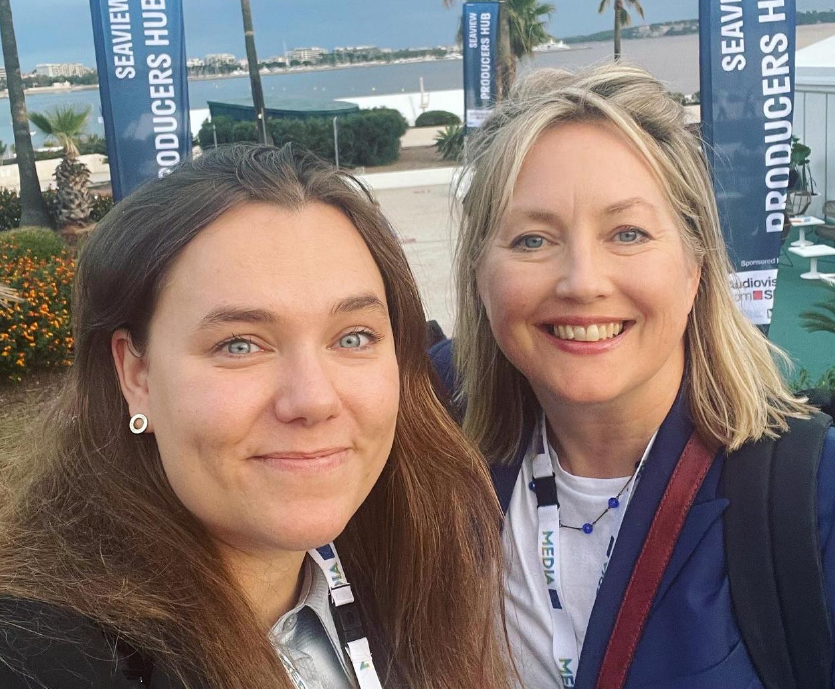
For Finnish producer, writer and director Anna Blom, internationalisation is less about moving from one market to another than about widening the creative and professional networks in which stories can be developed, financed and produced. Helsinki-based Jamedia production has spent more than two decades working across film and television, languages and borders. Now, the company is looking increasingly towards Europe, and towards Ireland in particular, as Blom develops the relationships and structures for the next stage of its international work.
Founded by Blom in 2003, Jamedia production describes itself as “a film and TV production company with empathy and edge.” Working in Finnish, Swedish and English through production-specific teams and established professional networks, the company combines the agility of a small production company with Blom’s experience across the creative and business sides of filmmaking. Throughout her career, character and story have remained central, with a particular interest in people and experiences outside conventional narratives.
A Producer Working Across Creative and Business Worlds
Blom’s career spans fiction and documentary, television and film, and the interconnected roles of producing, writing and directing. Her recent work also reflects a growing international dimension. In the 2026 feature film Earth Song, directed by Erol Mintaş and produced by Sons of Lumière, Blom and
Jamedia production are part of an international co-production involving Finnish and German partners and financing from, among others, the Finnish Film Foundation, Yle, Mitteldeutsche Medienförderung (MDM), Amos Andersons Fond, Nordisk Film & TV Fond and Finnish Impact Film Fund.
For Blom, however, internationalisation extends beyond attaching another country to an individual
production. Film and drama are developed through relationships between producers, creative talent, financiers, broadcasters and other partners working across different production and financing environments. For a producer working from a relatively small Nordic market, the ability to build and move between these relationships can become as important as the individual project itself, a condition widely recognised in research on small-nation cinemas (Hjort and Petrie, 2007). Ireland has increasingly become part of that wider professional landscape.
Ireland as a New Bridge in a European Network
Blom’s interest in working more internationally gained new momentum through SERIES’ WOMEN, the European career-enhancement and leadership programme for female drama series producers run by the Erich Pommer Institut. Combining professional development and mentoring with access to European industry markets and networks, the programme brought Blom into a wider community of producers and industry professionals. The experience strengthened her interest in developing her work and future projects within a broader European context, with Ireland subsequently emerging as a particularly interesting direction.
Its English-speaking screen industry, international orientation and connections with wider European
and UK production networks offered an interesting counterpart to Blom’s established Nordic
production environment. As Ireland became a more deliberate part of her international plans, the next question was how that interest could be developed into greater knowledge of the local industry, relevant professional relationships and a longer-term strategy.
Turning Internationalisation into Strategy
When Blom joined Kudos³, Aalto University’s audiovisual business development and advisory programme, Ireland was already emerging as a direction she wanted to explore, but the practical
network and longer-term strategy around it were still taking shape. Through tailored advising and
strategic sparring, Blom was able to examine the international direction more systematically, while the programme also connected her directly with professionals in the Irish audiovisual industry.
As the advisory work progressed, the Irish production landscape became more concrete. Industry
organisations and potential partners were mapped, and Blom continued developing relationships
initiated through the programme alongside contacts emerging through her own professional activity.
Fís Éireann/Screen Ireland and Ireland’s network of regional film offices became part of a more
detailed understanding of the country’s production environment, while Dublin and Galway emerged as important points for industry networking. What had begun as an interesting international direction was gradually developing into a network Blom could navigate and build upon. In economic geography terms, the Nordic production environment provides the dense everyday exchange of a local “buzz”, while connections such as those developing in Ireland act as “pipelines” through which knowledge from further afield enters and combines with local expertise, creating new possibilities for developing projects (Bathelt, Malmberg and Maskell, 2004).
The advisory process also created space to look beyond immediate contacts and individual projects. Working alongside Helsinki-based producer Mia Palmgren, Blom began exploring what a longer-term connection between Finnish, Irish and wider European production environments could make possible. Rather than beginning with a predetermined organisational structure, the work started from the kinds of projects, partnerships and opportunities that such a network might eventually support.
From a Map of Possibilities to a Route Forward
A future-oriented mapping exercise became one of the tools used in the advisory sessions to turn that thinking into a more defined direction. Instead of designing an organisation first, Blom and Palmgren worked from the future they wanted to make possible and considered what kinds of relationships, capabilities and structures might support it. The discussion ranged across feature film, drama, animation and content for younger audiences, while also examining how different projects might move through Finnish, Irish and European production and financing environments. Research on European television drama has similarly shown how series production increasingly draws on transnational partnerships, financing arrangements and audiences (Bondebjerg et al., 2017).
The exercise brought the complementary nature of Blom’s and Palmgren’s experience into sharper
focus. Blom’s work has centered on directing bold, authentic stories through documentaries and
children’s content, while Palmgren brings a business perspective shaped particularly around original IP and concept development. The value of combining these perspectives is not simply a question of scale. It lies in the possibility of connecting different creative approaches, professional relationships and ways of developing projects within a wider European network.
The work therefore moved away from designing internationalisation around a single production. Potential partners and networks were considered across Finland, Ireland, the Nordic countries, the UK and continental Europe, while different production and financing pathways were examined according to the needs of future projects. As part of the internationalisation advisory and sparring process, a two year roadmap was used to translate this longer-term direction into practical steps, helping identify where to invest time, which relationships to develop and which opportunities to pursue as the international network takes shape.
Building Trust for Building Productions
International co-production often develops through relationships long before a particular project brings partners together. A compelling slate may start a conversation, but collaborations that evolve over several years also depend on the people involved and their ability to navigate creative and financial uncertainty, changing circumstances and different ways of working. Research on European coproduction similarly emphasises that partnerships are often built on long-standing professional
relationships rather than formed around a single project (Hammett-Jamart, Mitric and Novrup Redvall, 2018).
Blom’s career across different areas of filmmaking has given her experience of projects from more than one perspective, from their early creative development through the realities of bringing them into production. Working in Swedish, Finnish and English has also made movement between languages and cultural contexts a natural part of her professional environment. As her network has extended beyond Finland, these experiences have become increasingly relevant to relationships with producers and other industry professionals working in different European production cultures.
Many of the connections now developing in Ireland and elsewhere in Europe build on relationships
accumulated over time through Jamedia production and Blom’s own work in the industry.
Internationalisation, in this sense, becomes part of the longer process through which people get to know one another professionally and future collaborations begin to emerge.
Nordic Roots, European Networks
For Jamedia production, internationalisation is becoming a widening field of relationships through
which projects and collaborations can develop. Blom’s experience has been shaped by the Finnish and Nordic production environment, while her growing connections in Ireland are opening new
relationships within a wider European context. In Hjort’s (2010) terms, this resembles a milieubuilding form of transnationalism, in which cross-border collaboration strengthens a producer’s home production environment rather than replacing it. Rather than defining in advance where future projects should belong, this network creates more possibilities for finding the right environment and partners for each of them.
The next phase will be shaped by what grows from these connections. Finland and Ireland are
becoming part of a broader professional landscape through which Blom and Palmgren can develop
relationships with producers and other industry partners across Europe, while the internationalisation work developed through Kudos³ moves from advising and strategic planning towards practice and concrete steps. What form the next stage will ultimately take will become clearer later this year.
References
Bathelt, H., Malmberg, A. and Maskell, P. (2004) ‘Clusters and knowledge: Local buzz, global
pipelines and the process of knowledge creation’, Progress in Human Geography, 28(1), pp. 31– 56.
Bondebjerg, I., Novrup Redvall, E., Helles, R., Lai, S.S., Søndergaard, H. and Astrupgaard, C. (2017)
Transnational European Television Drama: Production, Genres and Audiences. Cham: Palgrave
Macmillan.
Hammett-Jamart, J., Mitric, P. and Novrup Redvall, E. (eds) (2018) European Film and Television Coproduction:
Policy and Practice. Cham: Palgrave Macmillan.
Hjort, M. (2010) ‘On the plurality of cinematic transnationalism’, in Ďurovičová, N. and Newman, K.
(eds) World Cinemas, Transnational Perspectives. New York: Routledge, pp. 12–33.
Hjort, M. and Petrie, D. (eds) (2007) The Cinema of Small Nations. Edinburgh: Edinburgh University
Press.
Kudos³ Audiovisual Business Development Programme is part of the Digital Creative Industries and
Beyond (DCIB) project at Aalto University, co-funded by the European Union (European Regional
Development Fund), Helsinki-Uusimaa Regional Council and Aalto University. The programme
provides tailored business development advising and sparring to creative industry companies,
responding to company-specific needs in areas such as strategic and business development, content development, internationalisation and pathways for growth.
Nordic Roots, European Networks: Jamedia production Builds Connections between Finland and Ireland
Johanna Wartio, 2026